
Repeated customer stops
Sample several stops with different work. Compare movement, location, dispatch, supporting documents, and the driver's selected status instead of applying one status to every stationary period.
New York City fleet planning
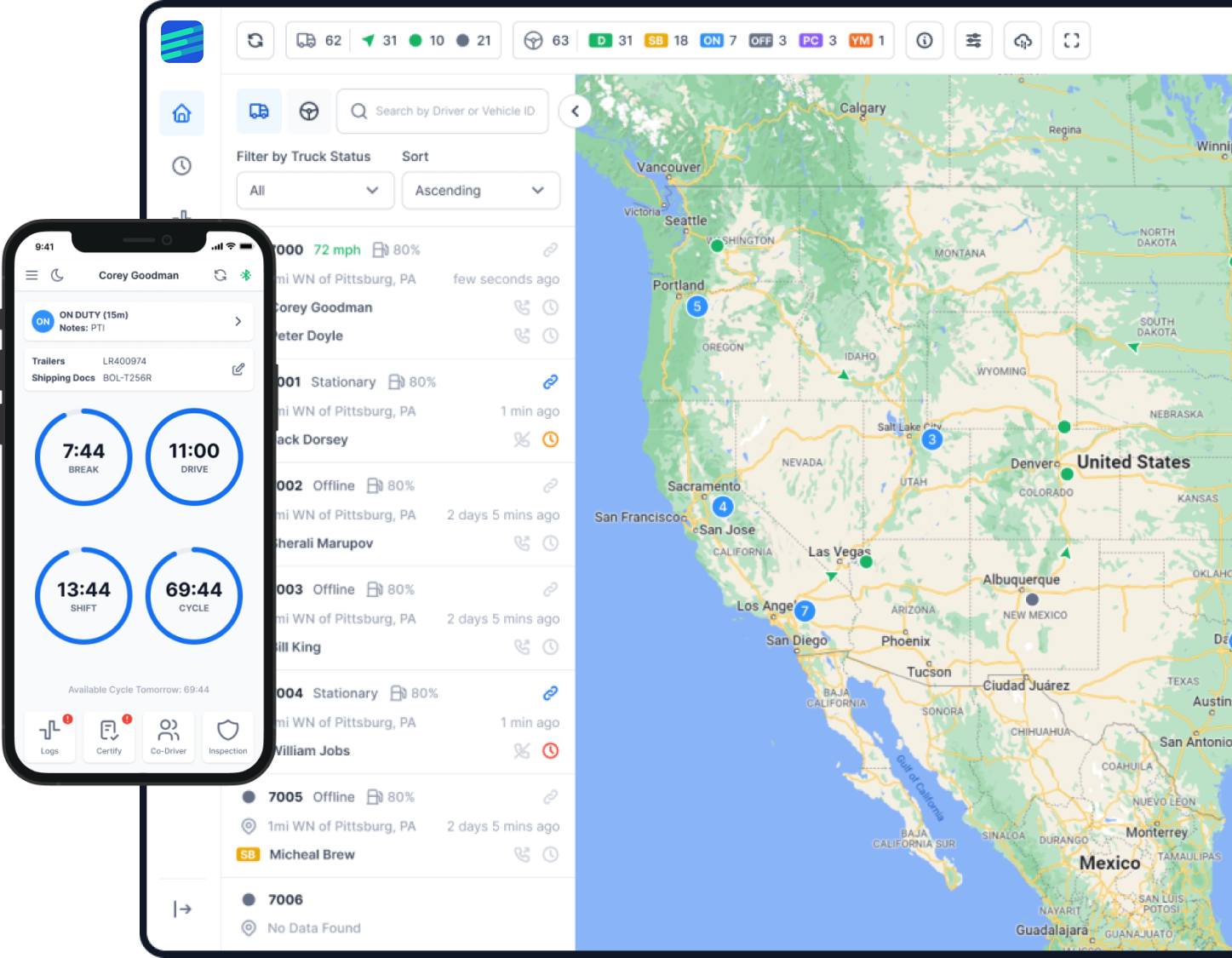
Plan ELD setup for your New York City fleet with remote guidance and support from Factor ELD. Use this guide to review a day with multiple stops, check how drivers record work between trips, and test access to records during an inspection.
Separate route rules from log rules
New York State DOT maintains freight-plan reports for current planning context. A fleet still must identify the current state and city authority for the exact route, vehicle configuration, restriction, and permit question. The ELD records activity; it does not choose or legalize the route.
Use a stop-heavy representative day with real loading, unloading, waiting, inspections, customer access, and dispatch changes. The driver and carrier must make duty-status decisions from actual work and rest, not from a geofence label or the fact that the vehicle is stationary.
Test location descriptions and event timing at the places most likely to create ambiguity. Preserve dispatch and supporting documents so an office reviewer can distinguish driving, on-duty work, off-duty time, personal conveyance, yard movement, and unassigned movement without rewriting the original record.
Finish with a roadside rehearsal and independent export review. The driver should be able to use the installed device's supported method; the office should be able to retrieve originals, annotations, edits, certifications, and the selected date range.
Decision checklist
Choose a difficult but routine city day and keep enough evidence to explain each status and movement afterward.
| Check | Evidence to keep |
|---|---|
| Verify the route authority | Save the current state and city source, route, vehicle configuration, restriction or permit decision, review time, and accountable dispatcher. |
| Map stops to actual work | Keep arrival, departure, loading, unloading, inspection, waiting, dispatch, and duty-status evidence for each sampled stop. |
| Review short and unassigned movements | Preserve automatic events, location, vehicle and driver assignment, special-category authorization, annotation, disposition, and audit history. |
| Test the exact installed system | Match FMCSA list data to hardware and software, then record truck/VIN, cable, phone/OS, permissions, engine data, and pass/fail tasks. |
| Complete transfer and export | Save the driver's roadside result, transfer receipt or display evidence, exact date-range export, record count, open/read check, and defects. |
Representative operations
Sample several stops with different work. Compare movement, location, dispatch, supporting documents, and the driver's selected status instead of applying one status to every stationary period.
Preserve the original plan, current authority consulted, new route, time known, vehicle configuration, dispatch communication, and resulting ELD events. Do not treat the ELD map as route authorization.
Review a movement near a customer or yard using the original event, assignment, location, purpose, special-category policy, driver annotation, office disposition, and audit history.
Have the driver locate the required information, retrieve the current and prior records, use the supported transfer or display method, and explain malfunction materials without administrator intervention.
Controlled rollout
The test should expose duty-status, location, route, and record-retrieval questions before a multi-vehicle rollout.
Record the current route sources, vehicle configuration, planned stops, expected work, driver, dispatcher, and any fact that affects applicability.
Save registry data, ELD hardware and software, truck and VIN, cable, phone and OS, permissions, driver account, and administrator roles.
Capture driving, loading, unloading, waiting, inspections, dispatch changes, annotations, edits, short movements, certification, and connectivity recovery.
Complete roadside display or transfer, export the sampled date range, trace the audit history, and match supporting documents.
Classify defects, assign owners, repeat failed tasks on the exact setup, and obtain written acceptance or rejection before expansion.
Terminology and limits
FMCSA describes ELDs on its official list as self-certified by their manufacturers and states that listing is not an agency endorsement. Verify the exact device name, hardware model, software version, registration ID, and current status before deployment.
This New York City guide does not establish route legality, permits, ELD applicability, HOS compliance, special-driving authorization, or a fact-specific exception. Use current authorities for the exact trip.
Primary sources
Reviewed August 10, 2026. Each source supports only the scope stated beside it. Recheck dynamic facts before dispatch or deployment.
Common questions
Factor ELD provides setup guidance and support remotely. Prepare your vehicle details and a typical stop sequence to discuss the setup your New York City fleet needs.
No. Use the current state and city route authorities for the exact vehicle and trip. Keep the route decision and its source with the dispatch record.
Record the actual work at each stop, then compare movement, timestamps, location, supporting documents, dispatch messages, and duty status. Stationary time is not automatically off-duty.
FMCSA lists devices self-certified by their manufacturers; listing is not an agency endorsement. Check the exact device and software version in the current list.
Require passed driver and office tasks, a successful roadside rehearsal, complete record export, closed and retested critical defects, and approval for the exact device and vehicle configuration.
Next step
Bring your vehicle details, route information, typical stops and questions about records or exports. Factor ELD can demonstrate its current product; your fleet remains responsible for route and regulatory decisions.